Guardianes
Palais Royal, Paris
2008


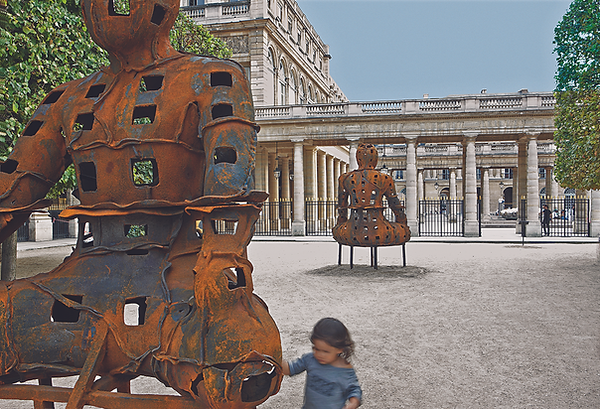

LA SOLEMNIDAD DE LA RUINA
(Extracto del catálogo de la exposición Guardianes. Xavier Mascaró dans les Jardins du Palais Royal*)*
Mascaró hunde sus raíces en la tradición española de la realización de imágenes religiosas realistas, una tradición que se extiende desde la escultura castellana hasta la pintura barroca española. Su lenguaje es figurativo, aunque se ocupa de lo no visible: comenzó presentando piezas procedentes del mundo del toreo —sillas de montar, banderillas, caballos, cuerdas— o de la vida cotidiana —juguetes, cruces, relicarios, etc.—, pero siempre cargadas de una presencia humana, o de lo que podríamos llamar, parafraseando a Maurice Blanchot, una huella humana, una ausencia humana. Una ausencia que sostiene una visión profundamente trágica de la vida, junto con una concepción de la historia como ruina y, al mismo tiempo, como carta de navegación hacia el futuro.
Aunque monumentales y solemnes, los dos temas centrales de esta exposición —los diez Budas Guardianes y la barca Departure— son también obras ceremoniales abiertas al futuro, no muy diferentes de la manera en que los fenicios concebían el alma de las embarcaciones, pues la navegación siempre fue entendida como una puerta que se abre hacia el futuro. En la solemnidad de la ruina, en la presencia de la ausencia, Mascaró traza la ruta de navegación hacia el futuro de su obra escultórica.
Extendidas a lo largo de dieciocho metros, las siete piezas que componen Departure están estructuradas casi como si fueran siete fragmentos de un naufragio rescatados por el artista en siete inmersiones hasta su estructura hundida. Mascaró presenta una barca crucificada en hierro, un material moldeado en arena. Después, en la pasión del fuego, el hierro simboliza su discurso sobre la muerte, sobre el paso del tiempo de aquella embarcación que una vez fue un navío ceremonial y que ahora es testigo y memoria. Del mismo modo, los diez Guardianes, que, aunque son guardianes, son también la defensa de una visión del mundo y de la memoria de una civilización. Diez piezas iguales, fundidas a partir del mismo molde interior, pero con texturas muy diferentes. Sus fracturas, la acción del tiempo sobre ellas, las huellas de la destrucción, son diferentes en cada una. Llevan dentro un caballo de Troya que hace que cada una de ellas estalle hacia el exterior de una manera distinta. Iguales en su simplicidad, pero diferentes en su configuración. Si la Barca marca o prefigura una ruta, un pasaje, aquí, en el Palais, los Budas trazan un nuevo camino.
Este conjunto de obras no se nos ofrece como una arqueología poética, como una estética de la ruina, sino como la huella del naufragio que podemos utilizar para reflexionar sobre el futuro. Toda la obra de Mascaró presenta la apariencia de una iconografía carbonizada, reconociendo los principios de la ascesis cisterciense, de la sobriedad en la iconografía, de una cierta musicalidad y de la alabanza de la ruina.
Entre sus primeras esculturas de hierro fundido, realizadas entre 1995 y 1998 (Solemnity, Gravity, Faith, Hope, Spirituality, etc.), encontramos ya obras como Solemnity, compuesta por tres piezas distribuidas en una sala, a tres metros de distancia unas de otras, una de ellas con una altura de 107 cm. Son como tres pesos de unas balanzas gigantescas que dominan todo el espacio. El pensamiento visual del artista se basa en una subversión de los objetos, en una reconfiguración más que en una paráfrasis —como, por ejemplo, Bacon con Velázquez—. Esas piezas citadas muestran también sus uniones, sus soldaduras, como elementos expresivos, del mismo modo que Julio González utiliza la soldadura no solo para realizar sus piezas, sino también como textura y forma de expresión. En Mascaró encontramos un uso constante del marco, de la armadura de hierro, como si fuera un pedestal. Si Brancusi eliminó el pedestal o lo convirtió en una parte integral de la escultura, Mascaró apoya muchas de sus piezas sobre un marco en el que “arma”, en el sentido medieval del término, sus ropajes, su imagen, su icono.
Las primeras barcas, tituladas Departure, fueron realizadas en 2000. Los marcos elevan el punto de vista para ayudar a que la imagen adquiera una presencia más monumental. El año 2002 terminó con piezas como Fossile, donde la piedra y el hierro juegan con la memoria de la escultura móvil de Alexander Calder, pero no desde el humor, sino desde la tristeza. La pieza exige prestar atención a dos contrarios: la movilidad y la fragilidad de los materiales que la componen, el hierro y la piedra. La estructura galvanizada reduce la noción de masa al mero esbozo del esqueleto —como en las torres eléctricas—, y el fósil emerge como una forma cristalizada. Ahora, ocho años después de su primera pequeña barca, la enorme pieza ceremonial de Departure muestra sus costillas, su esqueleto arquitectónico como forma pura, como el incienso de un viaje poético.
Estas nociones del esqueleto como viaje ya estaban presentes, antes incluso de las propias barcas, en 1996, en sus fascinantes cuadernos y dibujos. Además de anotaciones cotidianas o números de teléfono, en esos cuadernos encontramos las ideas preliminares para una escultura o para una serie, así como notas sobre cómo ejecutar una pieza: por ejemplo, Cabeza de caballo, las posibles ubicaciones para las correderas de hierro, o la deconstrucción de un toro en piezas como si fuera una columna vertebral, mientras escribe la idea de realizar una cadena fotográfica de un recién nacido “en un determinado número de eslabones fotográficos”. Después escribe: “las imágenes se entrelazan con imágenes de recipientes de vidrio llenos de agua (acumulación de jarras y botellas); un elemento líquido, transparencia”. Juega con ideas que más tarde plasmaría en hierro, Fossile o Bélier, vistas en secuencias que resultan transparentes debido a la ausencia de masa. En otra página escribe sobre cómo conseguir la textura de un camisón “remendando el interior del molde”.
Kosme de Barañano
Profesor de Historia del Arte
Guardianes
Bienal de la Habana
Malecón Habana, Cuba
2017


Guardianes
Paseo del Prado
Madrid, España
2010

