Archaeology of the Present
National Museum of Fine Arts, Havana
2025

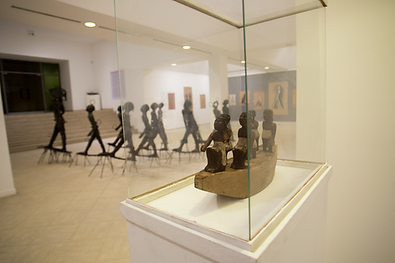
Sculpture in dialogue with Funerary Boat Model, from the permanent collection of the
Museo Nacional de Bellas Artes, Havana
Cuba. 2025
After an interminable journey, Xavier Mascaró’s works have reached the Museo Nacional de Bellas Artes.
He has arrived in Cuba not in the guise of a conqueror; he is interested in getting to know this context with its Spanish, African and Chinese roots. We are a nation shaped by a miscegenation unprecedented in the region. Mascaró’s work distances itself from historical narratives to challenge knowledge shaped exclusively by the European and Western canon. This artist’s gaze is conditioned by a personal life that has made him an artistic nomad: Paris, Barcelona, New York and Mexico City have gradually shaped a mythology that dates back to the origins of civilisation. We cannot act in the present and imagine the future if we do not have a clear awareness of where we come from. It might seem to be a matter settled by the European avant-garde movements of the twentieth century, but this symbolic process of despoilment must be revisited in order to situate ourselves at the exact moment we are living.
Mascaró bases his investigation on the study of ancestral cultures such as the Cycladic, which gravitates around the Aegean Sea and requires a profound analysis of its real contribution to the development of humanity; he dwells on the significance of ancient Babylon for an understanding of scientific thought; he points to the legacy of Pharaonic Egypt and revisits the Etruscan world. It is a pretext that alerts us to the distorsions of that concept of beauty inherited for years under the influence of Greco-Roman patterns, designed to fuel cultural and media fascism. Aesthetic
segregation no longer tolerates aging; it is racist, misogynistic, anthropocentric, and denies the levels of equity between the different ecosystems that come together on the planet.
The subject of women is a recurring issue in this artist’s work; it is represented in his sculptures through the Nubian queens, known as Kandakes, who ruled in southern Egypt, north of Sudan. These monarchs exercised power alongside men and often alone; their bloodlines enabled them to reign under a matriarchy. For years, they maintained the impetus of a regime which directed its efforts towards defending a territory that managed to halt and defeat the invasions of the Romans. Mascaró uses these ancient legends to reaffirm female empowerment by debunking the stigma of the so-called weaker sex that patriarchal structures sought to confine to domestic tasks. For this artist, materials are paramount; he enjoys the way iron springs from the earth as a result of the burial processes inherent in casting; he feels the emergence of the metal transformed into that body resurrected in a sacred tomb. He is captivated by the gentlenessof bronze, the instability of iron, the refraction of light with that fresh, ethereal touch that aluminium retains; he admires the ability to conduct electrical energy that we recognize in copper. The reactions of all these elements are part of the personal mythology that he defines through his art. Another essential feature of his work is the use of masks to reveal those hidden dynamics between presence and absence. This item of costume has a long pedigree in the annals of history; it is a means of bringing us closer to the divine, of going beyond the bounds of our identity and playing different roles, a way of mitigating our deficiencies and laying bare how difficult we find it to define ourselves as subjects. Each of these forms in Xavier Mascaró’s pieces is repeated, with infinite craving, in the attempt to achieve the individual image.
He points out that where there are differences we see only multiplicity. The maquettes he produces are shattered as if they had been buffeted by the passage of time; their structures are hollow and do not conceal the cavities between the various welding points; they are like fossils found from age-old civilisations. He is interested in creating a syntax that plays with chaos and accumulation.
Nothing in his works is finished; he incorporates any errors that may be present in their conception. We are part of an unfinished genesis; we reconstruct ourselves from small fragments that stand out in the way the artist organises his installations. One of the pieces that this comment applies to is
Guardians, which is notable for its solemnity, as if its figures were safeguarding a hidden, unfathomed heritage. In 2024, Xavier Mascaró took part in a exhibition entitled Forever is Now, held on the Giza plateau in Egypt. His installation, composed of a number of boats — a kind of imitation of those used to transport the pharaohs to the heavenly life that was supposed to occur after their death —
functioned as a site-specific, in dialogue between the present and eternity. The ephemeral past of human life on earth was contrasted with the timeless power of those pyramids; they have shown that aesthetic effectiveness depends on a regime of disconnection between the sociopolitical function of an icon and the sensitive response of viewers who freely embrace their moment of intimacy with one of the most emblematic monuments in international architecture. Xavier Mascaró’s boats are a journey carrying the pain of the exodus caused by colonisation and slavery, which remain present in those ad hoc floating structures that have become the means of escape for populations experiencing the crisis of survival in the Global South.
When we began to prepare this show, I wanted the artist to see a piece of special interest in our museum’s collection of Egyptian art. I refer to a Model of a Funerary Boat, made of polychrome wood, from the Middle Kingdom, Eleventh to Fourteenth Dynasties. The surprise of this discovery inspired him to create an original sculpture for this curatorial project. Xavier Mascaró’s new boat returns to that infinite pilgrimage between the living and the dead. This journey is dreamed of on the Nile and crosses the Gulf of Mexico to anchor in the mystery of an island that sails against the current in the midst of the storm.
Jorge Antonio Fernandez Torres
Director
Museo Nacional de Bellas Artes de Cuba
.jpg)


